 Calculator Metro
VO2 Max Calculator
VO2 max shows how well your body uses oxygen during hard exercise. A higher score often means better heart and lung fitness.
Find Your VO2 Max
Run as far as you can in 12 minutes. Enter the total distance in metres.
What is VO2 max?
VO2 max is the most oxygen your body can take in and use in one minute of hard exercise. The letters V and O2 stand for the volume of oxygen. The word max means the highest rate your body can reach.
The unit is mL/kg/min. That means millilitres of oxygen per kilogram of body weight per minute. The per kilogram part lets you compare people of different sizes. A heavier person may use more oxygen in total yet score lower per kilogram.
A higher score often means better heart and lung fitness. It shows how well your heart pumps blood and how well muscles use oxygen. Athletes tend to score high. People who rarely exercise tend to score low.
Scores are often shown as METs too. One MET equals 3.5 mL/kg/min, the oxygen use at rest. Divide your score by 3.5 to get METs. A score of 42.4 equals 12.1 METs.
This tool gives an estimate, not a lab result. A lab test measures the air you breathe out while you work to exhaustion. Field tests predict that number from running or walking. The estimate tracks fitness. It is not medical advice and it does not diagnose any condition.
Fitness Categories
Your category depends on your age and sex. The same score can mean a different level for different people.
| Age group | Men: Good starts at | Men: Superior starts at | Women: Good starts at | Women: Superior starts at |
|---|---|---|---|---|
| 20 to 29 | 42 | 53 | 34 | 45 |
| 30 to 39 | 38 | 49 | 31 | 41 |
| 40 to 49 | 36 | 47 | 28 | 38 |
| 50 to 59 | 33 | 44 | 26 | 35 |
| 60 and over | 30 | 41 | 23 | 32 |
Poor is below Fair. Fair is below Good. Good is a solid level for most adults. Excellent is above Good. Superior is the top level.
Full norms by age and sex
The table above uses this tool’s own simplified bands. The tables below show the commonly cited norms from the American College of Sports Medicine (ACSM, 11th edition, 2021). They use Cooper Institute percentile bands. Their cut-offs sit a little higher. A score can sit in a different band in each set.
| Men, age | Fair from | Good from | Excellent from | Superior from |
|---|---|---|---|---|
| 20 to 29 | 41.7 | 45.4 | 51.1 | 55.4 |
| 30 to 39 | 40.5 | 44.0 | 48.3 | 54.0 |
| 40 to 49 | 38.5 | 42.4 | 46.4 | 52.5 |
| 50 to 59 | 35.6 | 39.2 | 43.4 | 48.9 |
| 60 to 69 | 32.3 | 35.5 | 39.5 | 45.7 |
| Women, age | Fair from | Good from | Excellent from | Superior from |
|---|---|---|---|---|
| 20 to 29 | 36.1 | 39.5 | 43.9 | 49.6 |
| 30 to 39 | 34.4 | 37.8 | 42.4 | 47.4 |
| 40 to 49 | 33.0 | 36.3 | 39.7 | 45.3 |
| 50 to 59 | 30.1 | 33.0 | 36.7 | 41.1 |
| 60 to 69 | 27.5 | 30.0 | 33.0 | 37.8 |
Below Fair is Poor. Superior starts at the 95th percentile, Excellent at the 80th, Good at the 60th and Fair at the 40th. These are ranks within a tested group, not clinical cut-offs.
Scores fall with age, so the bands drop each decade. Women score lower on average than men at the same age. Compare your score with people of your own age and sex.
How It Works
The Cooper test uses one simple formula. VO2 max equals distance in metres minus 504.9, then divided by 44.73. Run farther in 12 minutes to get a higher score.
The Rockport test uses a standard formula. It uses weight, age, sex, walk time, and ending heart rate. Faster walks and lower heart rates give higher scores.
- Choose Cooper or Rockport above.
- Enter your test result and your age and sex.
- Press Calculate VO2 Max to see your score.
- Check the table to find your fitness category.
The Cooper 12-minute run test
Kenneth Cooper published this test in 1968. He compared 12-minute run distances with lab scores in 115 US Air Force men. The link was strong at 0.897.
Warm up first. Then run on a flat, measured course, such as a 400 m track. Run as far as you can in exactly 12 minutes. Keep an even pace. A fast start often leads to a slow finish. Record the total distance in metres.
VO2 max = (distance in metres – 504.9) / 44.73
With distance in kilometres, the same line reads VO2 max = 22.351 x distance (km) – 11.288. The two forms match apart from rounding. Each extra 100 m adds about 2.2 to the score.
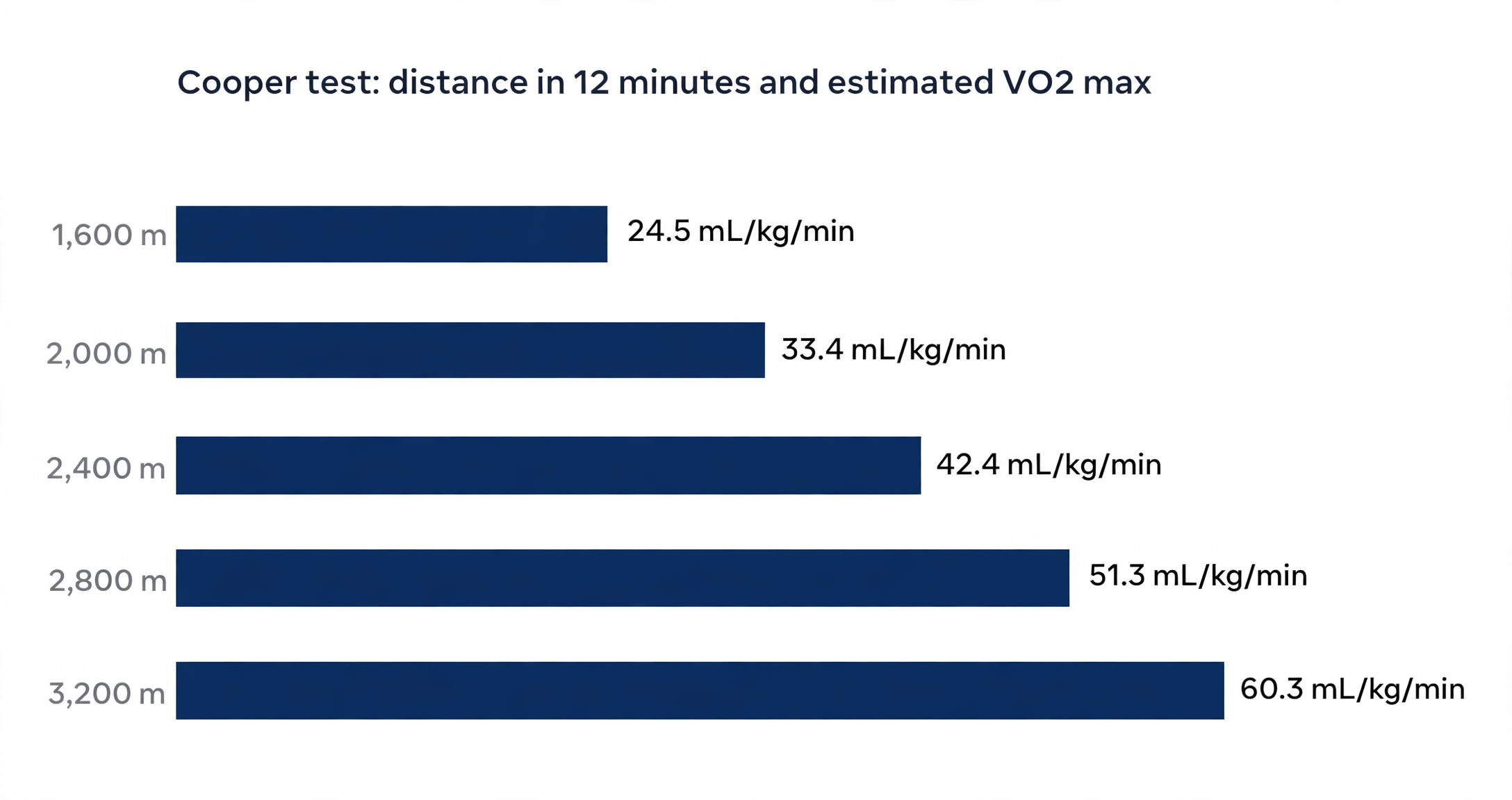
| Distance in 12 minutes | Estimated VO2 max |
|---|---|
| 1,600 m | 24.5 |
| 2,000 m | 33.4 |
| 2,400 m | 42.4 |
| 2,800 m | 51.3 |
| 3,200 m | 60.3 |
The Rockport 1-mile walk test
Kline and colleagues published this test in 1987. They fitted the formula on 343 healthy adults aged 30 to 69. It suits people who cannot run hard.
Walk one mile (1,609 m) as fast as you can on a flat track. Do not run. Record your time in decimal minutes: 15 minutes 30 seconds is 15.5, not 15.30. Take your heart rate at once when you finish.
VO2 max = 132.853 – 0.0769 x weight (lb) – 0.3877 x age + 6.315 x sex – 3.2649 x time (min) – 0.1565 x heart rate (bpm)
Sex is 1 for men and 0 for women. Weight must be in pounds. To convert, multiply kilograms by 2.2046. So 68 kg is 149.9 lb. Time is the strongest term. Each minute cut from the walk adds about 3.3 to the score.
Cooper or Rockport: which test?
| Point | Cooper run | Rockport walk |
|---|---|---|
| Effort | Maximal | Submaximal |
| Duration | Fixed 12 minutes | Time to walk 1 mile |
| Needs | Distance run | Walk time and finish heart rate |
| Built on | 115 young active men | 343 adults aged 30 to 69 |
| Best for | People who can run hard | Beginners, older adults, non-runners |
The Cooper test is a maximal effort. It is not right for sedentary people without medical clearance, or for anyone who cannot run. If that is you, choose the Rockport walk.
A third method: heart-rate ratio
Some tools offer a third method that uses resting and maximum heart rate only. The formula is VO2 max = 15.3 x HRmax / HRrest. Uth and colleagues tested it in 46 well-trained men. This tool does not include it.
Worked examples
These four cases show each step. You can check every number with the formulas above.
Cooper: 2,400 m in 12 minutes
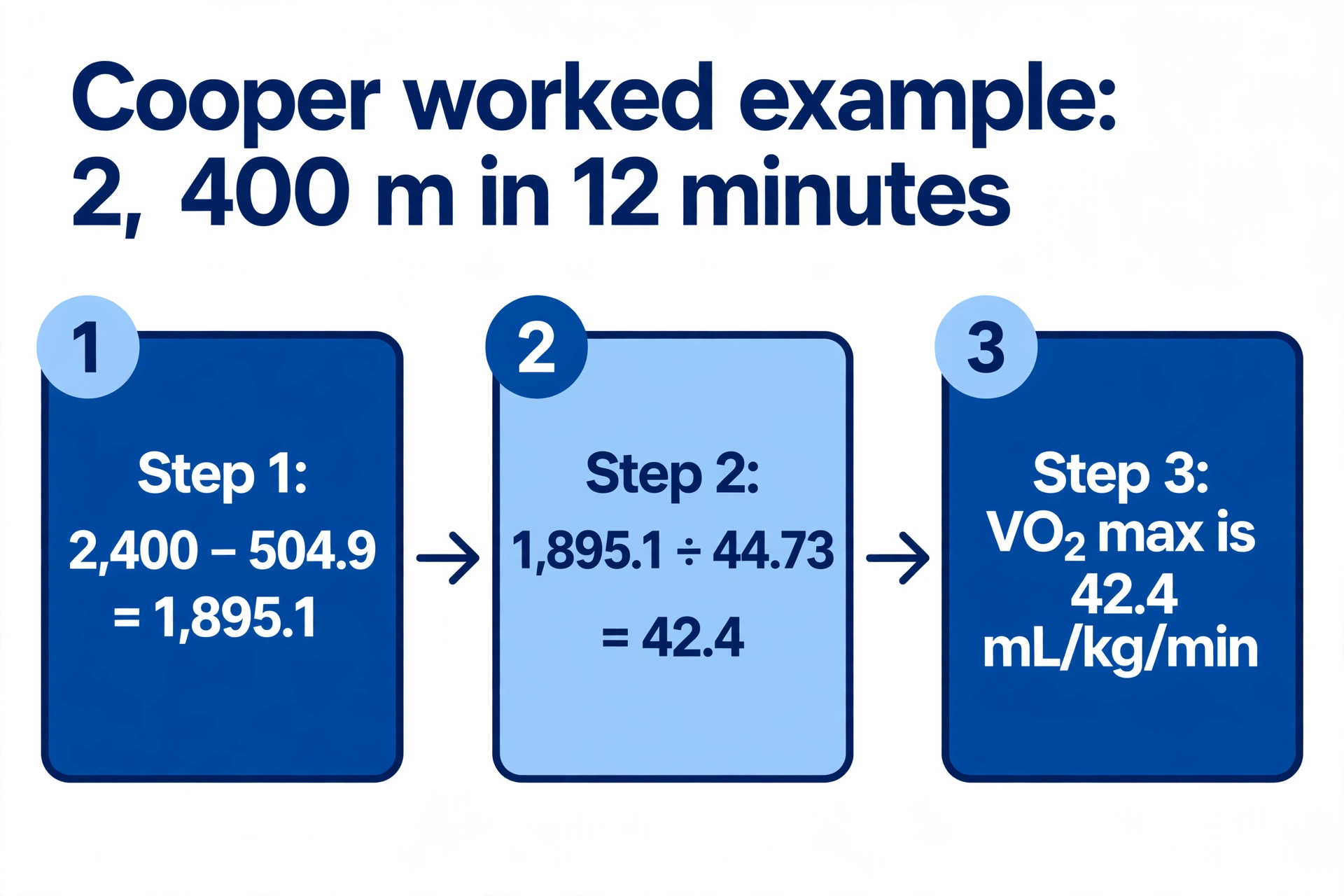
First, subtract: 2,400 – 504.9 = 1,895.1. Next, divide: 1,895.1 / 44.73 = 42.4 mL/kg/min. That is 12.1 METs. On the ACSM norms, it is Fair for a man aged 30 to 39. It is Good on this tool’s own bands.
Cooper: 2,800 m in 12 minutes
First, subtract: 2,800 – 504.9 = 2,295.1. Next, divide: 2,295.1 / 44.73 = 51.3. The score is 51.3 mL/kg/min. The extra 400 m adds about 8.9 to the score. That is four lots of 2.2.
Rockport: woman aged 45, 68 kg, 15.5 minutes, heart rate 130
First, convert the weight: 68 x 2.2046 = 149.9 lb. Sex is 0 for a woman.
| Term | Sum | Value |
|---|---|---|
| Weight | 0.0769 x 149.9 | 11.53 |
| Age | 0.3877 x 45 | 17.45 |
| Time | 3.2649 x 15.5 | 50.61 |
| Heart rate | 0.1565 x 130 | 20.35 |
Now add it up: 132.853 – 11.53 – 17.45 – 50.61 – 20.35 = 32.9 mL/kg/min. On the ACSM norms, that is Fair for a woman aged 40 to 49.
Rockport: man aged 40, 180 lb, 14.0 minutes, heart rate 150
Sex is 6.315 for a man.
| Term | Sum | Value |
|---|---|---|
| Weight | 0.0769 x 180 | 13.84 |
| Age | 0.3877 x 40 | 15.51 |
| Time | 3.2649 x 14 | 45.71 |
| Heart rate | 0.1565 x 150 | 23.48 |
Now add it up: 132.853 – 13.84 – 15.51 + 6.315 – 45.71 – 23.48 = 40.6 mL/kg/min. On the ACSM norms, that is Fair for a man aged 40 to 49.
How to improve your VO2 max
You can raise your score at any age. Most adults gain 3 to 15 percent in 8 to 12 weeks of steady work. Gains are fastest from a low start and slow as fitness rises. Genes set the ceiling.
Build an easy aerobic base first. Aim for two or three sessions a week of 30 to 60 minutes. Keep the pace easy enough to talk in full sentences. This is often called Zone 2. Walk, jog, cycle or swim.
Add one interval session a week. A proven form is 4 x 4 minutes hard with 3 minutes easy between each hard block. Warm up well first. Hard means you can speak only in short phrases.
Add strength work twice a week. Strong legs use less oxygen for the same pace. That helps running economy.
Retest every 6 to 8 weeks. Use the same test, course and conditions. One test shows a snapshot. A trend over months shows real change.
Rest matters too. Hard days need easy days between them. Do not test when ill, tired or in extreme heat. The result will read low.
VO2 max vs VDOT
VDOT is a running score, not the same as VO2 max. Jack Daniels built it from race times. It blends true VO2 max with running economy: how little oxygen you use at a given pace.
Two runners can share the same VO2 max yet hold different VDOTs. The runner with better economy runs faster at the same oxygen cost. So VDOT predicts race times better.
Use VO2 max to track aerobic fitness. Use VDOT to set training paces and predict race times. Our site has a separate tool for it. Try the VDOT calculator with a recent race time.
Accuracy and limits
Field tests estimate the lab value. They do not measure it. A single result can sit several mL/kg/min away from a lab score. The Rockport formula has a standard error of 5.0 mL/kg/min.
The equations came from narrow groups. Cooper used young active men. Rockport used healthy adults aged 30 to 69. Results are less sure outside those groups.
Only a lab test with gas analysis measures oxygen uptake direct. It needs trained staff and costly kit. Field tests trade some exactness for ease. Their strength is tracking change in the same person over time.
Do not use this estimate to diagnose disease or to set treatment. Do not use it as medical clearance. If you have heart or lung disease, are pregnant, or are new to hard exercise, ask a doctor first. The same applies if you take heart-rate drugs. Stop the test at once for chest pain, dizziness, faintness or unusual breathlessness. Seek medical help if those signs appear.
Common mistakes
Five errors cause most wrong results.
| Mistake | What goes wrong | Do this instead |
|---|---|---|
| Fast start in Cooper | You fade and cover less distance | Pace it evenly from the start |
| Late heart-rate reading | Your pulse drops fast after you stop | Take it at once at the finish |
| Time typed as 15.30 | 15 minutes 30 seconds is 15.5, not 15.30 | Divide seconds by 60 first |
| Weight typed in kg | The formula needs pounds | Multiply kg by 2.2046 first |
| Mixing tests | Cooper and Rockport can disagree | Repeat the same test each time |
Weather and surface matter too. Wind, heat, altitude and hills change the result. Test at the same place in similar conditions.
Frequently Asked Questions
What is a good VO2 max?
Good depends on your age and sex. A score of 42 is Good for a man aged 30 to 39. The same score is Superior for a woman in that age group.
Which test should I choose?
Choose Cooper if you can run hard for 12 minutes. Choose Rockport if you prefer a fast walk. Both tests give a useful estimate.
Can I improve my VO2 max?
Yes. Regular aerobic exercise can raise it over weeks and months. Mix easy runs with harder interval sessions. Rest well between hard days.
Is this a medical test?
No. This is a fitness estimate from a field test. A lab test gives a more exact result. Talk with your doctor before hard exercise if you have health concerns.
Why does sex affect the category?
Men and women have different average heart size and muscle mass. The bands reflect those group differences. They help you compare with people like you.
What does my score mean in plain words?
It is the most oxygen your body can use in one minute of hard exercise. A higher number means a stronger heart and lungs.
How accurate is this calculator?
It gives a sound estimate, not a lab value. One result can sit several points away from a lab score. The trend over months matters more than one number.
How often should I retest?
Retest every 6 to 8 weeks. Use the same test and course. Testing every week adds noise and tells you little.
Can a smartwatch replace this test?
No. A watch gives its own estimate from heart rate and pace. Use one method at a time to track change.
What is the difference between VO2 max and VDOT?
VO2 max is the top rate of oxygen use. VDOT blends that rate with running economy to predict race times. Our VDOT calculator works from a recent race time.
Key terms
| Term | Meaning |
|---|---|
| VO2 max | The most oxygen the body can use in one minute of hard exercise. |
| mL/kg/min | Millilitres of oxygen per kilogram of body weight per minute. |
| MET | One MET is 3.5 mL/kg/min, the rate at rest. |
| Cooper test | A 12-minute run scored by distance. |
| Rockport test | A fast 1-mile walk scored by time and finish heart rate. |
| VDOT | A running score from race times that blends VO2 max with running economy. |
| Field test | A test done outside a lab. |
| Lab test | A gas-analysis test that measures oxygen uptake direct. |