 Calculator Metro
ACT Score Calculator
Enter your raw score for each test. See your scaled scores and your composite.
Work Out Your ACT Score
Type the number of correct answers for each test. Press Calculate to see the scaled scores.
The table is the standard ACT conversion table. The exact table can shift a little by test form. Your real score comes from the table for your test date.
What is an ACT score?
The ACT is a college admissions test used in the United States. It tests English, Math, Reading and Science. Each section gets a scaled score from 1 to 36. The composite is the average of the section scores. Both use the ACT score range 1 to 36.
A raw score is the count of correct answers in one section. An ACT scaled score turns an ACT raw score into a score from 1 to 36. The change matters because test forms differ a little in difficulty. A scaled score means the same thing on any form. This ACT score calculator turns those raw counts into scaled scores and a composite.
There is no penalty for a wrong answer. A blank answer and a wrong answer both score zero. So it pays to answer every question, even when you must guess.
The four ACT sections at a glance
| Section | Questions | Time | What it tests |
|---|---|---|---|
| English | 75 | 45 minutes | Grammar, punctuation and style |
| Math | 60 | 60 minutes | Algebra, geometry and trigonometry |
| Reading | 40 | 35 minutes | Reading |
| Science | 40 | 35 minutes | Scientific reasoning |
The test has 215 questions in total. It takes 175 minutes without breaks. The optional Writing test adds one essay in 40 minutes. Writing has its own score from 2 to 12. It does not change the composite.
Two extra scores come from the same test. The ACT STEM score averages Math and Science. The ACT ELA score averages English, Reading and Writing.
How It Works
Each raw score counts your correct answers. There is no penalty for wrong answers.
The table turns each raw score into a scaled score from 1 to 36.
The composite is the mean of the four scaled scores. It rounds to the nearest whole number.
A raw score of 60 in English gives a scaled score of 29.
A perfect raw score gives a scaled score of 36 in each test.
The ACT composite score formula is simple. Composite = (English + Math + Reading + Science) / 4. The worked examples below show how to calculate ACT score averages from raw scores. Then round to the nearest whole number. A fraction of one half or more rounds up. A fraction below one half rounds down.
Worked example: the scores in the tool
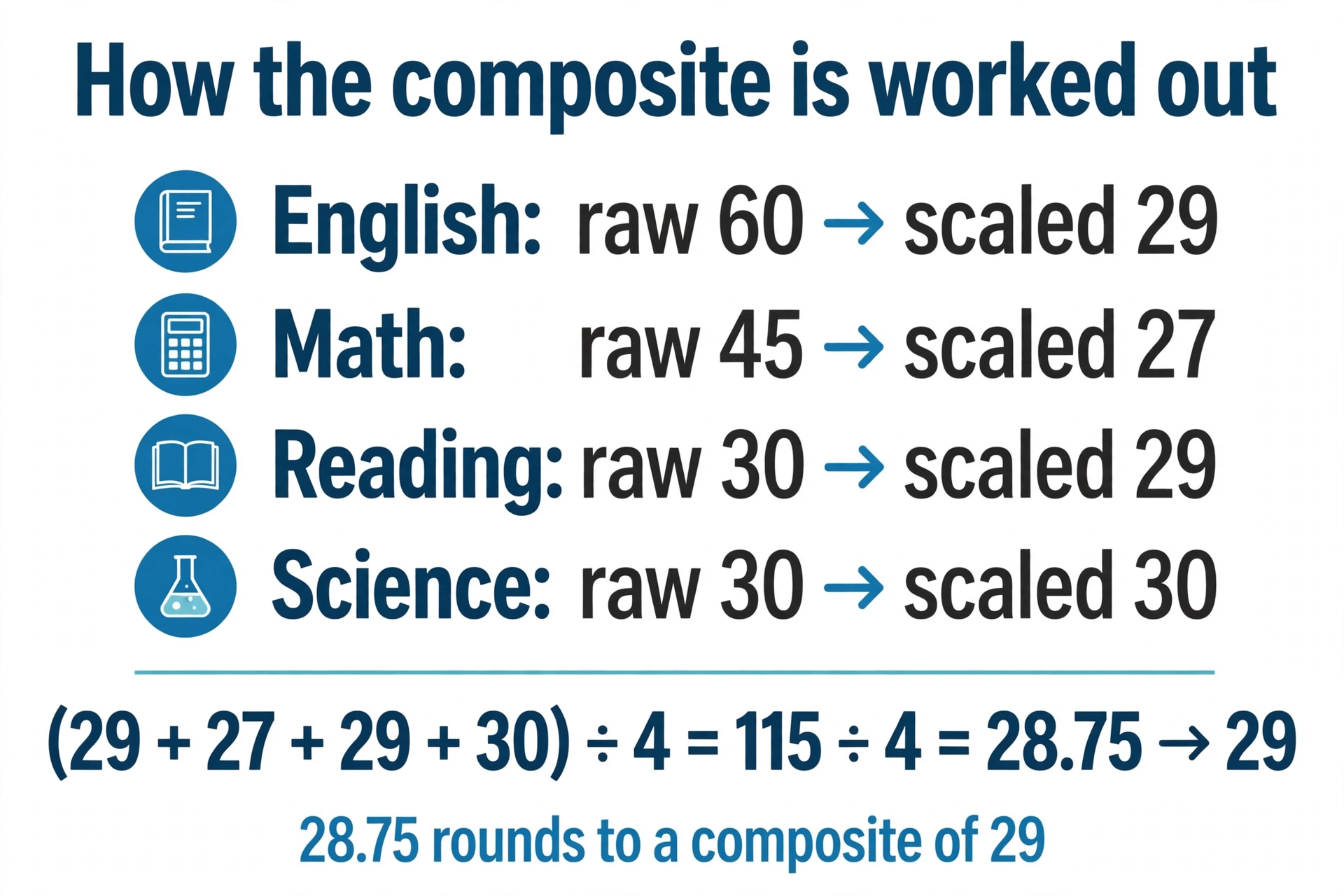
The tool starts with raw scores of 60, 45, 30 and 30. The ACT score conversion turns them into scaled scores of 29, 27, 29 and 30. Add them: 29 + 27 + 29 + 30 = 115. Divide by 4: 115 / 4 = 28.75. That rounds to a composite of 29.
How rounding works
Three cases show the rule. First, 28, 26, 30 and 24 add to 108. Then 108 / 4 = 27. Second, 25, 27, 24 and 26 add to 102. Then 102 / 4 = 25.5. A half rounds up, so the composite is 26. Third, 25, 26, 25 and 25 add to 101. Then 101 / 4 = 25.25. That rounds down to 25.
A perfect ACT score of 36 needs near perfect sections. Scores of 36, 36, 36 and 35 add to 143. Then 143 / 4 = 35.75. That rounds to 36.
This tool averages all four sections. That is the rule for tests taken before September 2025. Newer tests use a three section average. See “The 2025 Enhanced ACT change” below.
English: Raw to Scaled
| Raw score | Scaled score |
|---|---|
| 75 | 36 |
| 70 | 34 |
| 65 | 32 |
| 60 | 29 |
| 55 | 27 |
| 50 | 25 |
| 45 | 24 |
| 40 | 22 |
| 35 | 20 |
| 30 | 18 |
| 25 | 16 |
| 20 | 14 |
| 15 | 12 |
| 10 | 9 |
| 5 | 5 |
| 0 | 1 |
What your score means
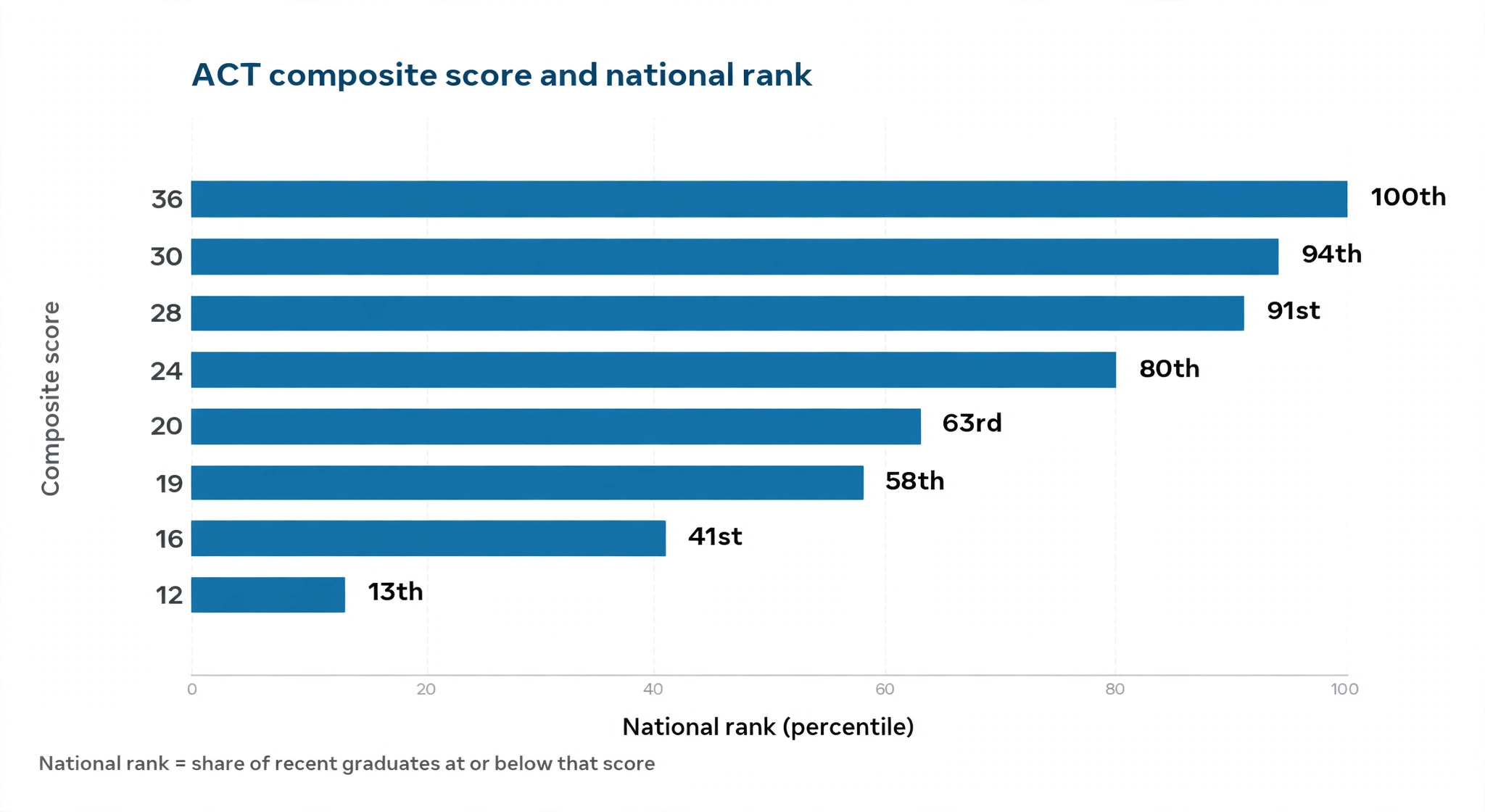
A composite alone says little. Its national rank says more. The rank is the share of recent graduates who scored at or below your score. A rank of 80 means you beat 80 in 100 test takers.
| Composite | National rank |
|---|---|
| 36 | 100 |
| 30 | 94 |
| 28 | 91 |
| 26 | 86 |
| 24 | 80 |
| 20 | 63 |
| 19 | 58 |
| 18 | 52 |
| 16 | 41 |
| 12 | 13 |
Source: ACT score percentiles (ACT Score National Ranks), based on graduates of 2024, 2025 and 2026.
Read the ACT score ranges this way. A score of 30 or more puts you in the top 6 in 100. A score of 28 or 29 puts you near the top 10. A score of 24 to 26 beats about 4 in 5 test takers. A score of 20 to 23 sits above the middle, and 19 sits near the middle.
The average ACT score for the class of 2025 was 19.4. About 1,380,130 students took the test. Section means were English 18.4, Math 18.9, Reading 20.0 and Science 19.6.
ACT also sets ACT score benchmarks. They mark the score tied to a good chance of a B or better in a first year course. The benchmarks are English 18, Math 22, Reading 22 and Science 23. The STEM benchmark is 26 and the ELA benchmark is 20. In the class of 2025, 20 in 100 students met all four benchmarks.
The 2025 Enhanced ACT change
The ACT changed in 2025. Online tests moved in April 2025. Paper tests followed in September 2025. The new test is shorter, and Science is now optional.
| Section | Legacy test | Enhanced test |
|---|---|---|
| English | 75 questions, 45 minutes | 50 questions, 35 minutes |
| Math | 60 questions, 60 minutes | 45 questions, 50 minutes |
| Reading | 40 questions, 35 minutes | 36 questions, 40 minutes |
| Science | 40 questions, 35 minutes | 40 questions, 40 minutes, optional |
| Total | 215 questions, 175 minutes | 131 scored questions, 125 minutes |
The composite changed too. On the new test it averages English, Math and Reading only. Science still gets its own score from 1 to 36. It just does not count in the composite.
Some questions do not count. Each section holds a few trial questions. English prints 50 but counts 40. Math prints 45 but counts 41. Reading prints 36 but counts 27. Science prints 40 but counts 34.
Worked example for the new Enhanced ACT score rule: English 26, Math 30 and Reading 25 add to 81. Then 81 / 3 = 27. The composite is 27. The tool on this page still uses the older four section rule. It fits score reports from tests taken before September 2025. If your report is newer, average your three core scores by hand.
ACT superscore
A superscore mixes your best sections from different test dates. ACT builds it for you once you have tested more than once since September 2016.
Take two sittings. On the first, English 24, Math 28, Reading 26 and Science 22 give a composite of 25. On the second, English 28, Math 25, Reading 30 and Science 26 give 27.25, which rounds to 27. The best scores are English 28, Math 28, Reading 30 and Science 26. They add to 112. Then 112 / 4 = 28. The superscore is 28. That beats both single sittings.
On the new test the superscore uses three sections. The best English 28, Math 28 and Reading 30 add to 86. Then 86 / 3 = 28.67. That rounds to 29.
Not every college uses a superscore. Some take your highest single sitting instead. Check each college admissions page before you send scores.
This page is a single sitting ACT composite score calculator. It does not mix sittings. To find your superscore, take your best score in each section and average them with the steps above.
ACT vs SAT
The ACT and the SAT are both college admissions tests. Most colleges accept either one. Neither test is better in itself. The choice comes down to which format suits you.
| Feature | ACT | SAT |
|---|---|---|
| Sections | English, Math, Reading, Science | Reading and Writing, Math |
| Score scale | 1 to 36 | 400 to 1600 |
| Core time | 125 minutes (new test) | 134 minutes |
| Science | Optional section | No science section |
| Essay | Optional | None |
For an ACT to SAT conversion, use the official concordance tables. ACT and the College Board built them together in 2018. They match scores that mean the same thing. They do not predict how you would score on the other test.
| ACT composite | SAT total | SAT range |
|---|---|---|
| 36 | 1590 | 1570 to 1600 |
| 34 | 1500 | 1490 to 1520 |
| 30 | 1370 | 1360 to 1380 |
| 28 | 1310 | 1300 to 1320 |
| 26 | 1240 | 1230 to 1250 |
| 24 | 1180 | 1160 to 1190 |
| 20 | 1040 | 1030 to 1050 |
| 18 | 970 | 960 to 980 |
This ACT score table covers composites from 9 to 36. No official SAT value exists for a composite below 9. The tables date from 2018 and still guide colleges today.
As a rule of thumb, a 30 on the ACT lines up with about 1370 on the SAT. A 24 lines up with about 1180. Use the range, not one number, when you compare ACT scores for colleges.
How colleges use your ACT score
Colleges use your score in three main ways. First, admissions. Many colleges print the middle 50 percent range of admitted students. That is the span from the 25th to the 75th percentile. A score at or above the 75th mark helps your case. A score below the 25th mark weakens it.
Second, merit scholarships. Some awards set a score floor. A higher composite can unlock more aid. Check each college aid page for its cut offs.
Third, course placement. A strong Math score can place you past a basic course. A strong English score can do the same for writing. Each college sets its own bars.
Many colleges are now test optional. That means you choose whether to send scores. If your score sits below a college middle range, you may do better to withhold it. If it sits above the range, send it. Always check the current policy on the college own site.
Your score is one part of the file. Grades, courses, essays and activities count too.
How to improve your ACT score
Start with your weakest section. It has the most room to grow. One section can lift the whole composite. Each composite point needs 4 more section points in total on the four section rule.
Rounding can help. Say your sections add to 100, a composite of 25. Two more points take the total to 102. Then 102 / 4 = 25.5, which rounds to 26. Small gains can move the composite by a full point.
Set a target and work back. Say your sections are 26, 25, 27 and 24. They add to 102. A target of 28 needs a total of 112, since 28 x 4 = 112. That is a gap of 10 points across the four sections. Split it where you can gain most.
Use real practice tests. Grade them with the table from that test form. Track which question types cost you points. Then drill those types first.
Learn the pace of each section. On the old test, English gives about 36 seconds per question. Math gives 60 seconds. Reading and Science give about 53 seconds each. The new test gives more time per question. Even so, never leave a question blank.
Retake the test if your score is below your target. A second sitting often lifts the score and builds a superscore.
FAQ
What is a raw score?
It is the count of correct answers. Each test has its own total.
What is a scaled score?
It is a score from 1 to 36. It lets ACT compare test forms.
How is the composite worked out?
Add the four scaled scores and divide by four. Round to the nearest whole number.
What is a good ACT score?
The mean composite is near 19. A score of 24 or more beats most test takers.
Is this ACT score calculator free?
Yes, it is free. You can use it as often as you like. No account is needed.
Does Science still count in the composite?
On tests from September 2025, no. The composite averages English, Math and Reading only. Science is optional and gets its own score. The tool on this page uses the older four section rule for earlier tests.
How do I work out my superscore?
Take your best score in each section from any test dates. Add them and divide by the number of sections. Round to the nearest whole number. ACT builds it for you after two sittings.
Can this ACT score calculator work out my superscore?
No. It works out one sitting at a time. Use your best section scores and the steps in the superscore section above.
What is a 36 on the ACT in SAT points?
A 36 lines up with 1590 on the SAT. The official range is 1570 to 1600. The link comes from the 2018 ACT and College Board concordance tables.
What is the STEM score?
It averages your Math and Science scores. Math 26 and Science 25 give 25.5, which rounds to 26. It shows strength in maths and science.
How many questions do I need right for a 30 in each section?
It varies by test form. On this page table, English needs 61, Math needs 50, Reading needs 31 and Science needs 30. Your form may differ by a point or two.
Do colleges prefer the ACT or the SAT?
No. Most colleges accept either test. Pick the format that suits you best.
Key terms
| Term | Meaning |
|---|---|
| Raw score | Correct answers in one section. |
| Scaled score | ACT scale score from 1 to 36. |
| Composite | Average of the section scores, rounded. |
| Superscore | Best section scores across sittings, averaged. |
| National rank | Share at or below a score. |
| STEM score | Average of Math and Science. |
| ELA score | Average of English, Reading and Writing. |
| Benchmark | Score linked to college course readiness. |
| Concordance | Official table that matches ACT and SAT scores. |