 Calculator Metro
VDOT Calculator
VDOT turns one race time into a fitness score. That score predicts other race times and sets training paces.
This Jack Daniels VDOT calculator turns one race result into a full training plan. It is a VDOT running calculator for race times and training paces. VDOT is short for V-dot-O2max, the scientific way to write VO2max. Coach Jack Daniels built the score with Jimmy Gilbert in 1979. One number sets five training paces. It also predicts race times at other distances. What is VDOT? It is one score for your fitness. The VDOT meaning in running is simple: one score for fitness.
< /section>
Find Your VDOT Score
Equal Race Times
These times match the same VDOT score. They show what you could run at other distances with the same fitness.
Use the table below as your VDOT race predictor.
Find your recent time in one column.
Read your score on the left.
Then read across for times at other distances.
Each row holds one score, so a time between rows means a score between them.
These are your VDOT equivalent race times.
The VDOT 5K to marathon table runs from 5K to marathon.
Check your result in the VDOT table above.
This VDOT chart runs from 30 to 85.
| VDOT | 5K | 10K | Half marathon | Marathon |
|---|---|---|---|---|
| 30 | 30:41 | 1:03:49 | 2:21:17 | 4:49:49 |
| 35 | 26:59 | 56:02 | 2:04:13 | 4:16:06 |
| 40 | 24:06 | 50:01 | 1:50:54 | 3:49:37 |
| 45 | 21:49 | 45:13 | 1:40:14 | 3:28:16 |
| 50 | 19:56 | 41:20 | 1:31:31 | 3:10:40 |
| 55 | 18:22 | 38:06 | 1:24:16 | 2:55:55 |
| 60 | 17:03 | 35:22 | 1:18:09 | 2:43:22 |
| 65 | 15:55 | 33:02 | 1:12:54 | 2:32:35 |
| 70 | 14:56 | 31:01 | 1:08:23 | 2:23:13 |
| 75 | 14:04 | 29:15 | 1:04:25 | 2:14:59 |
| 80 | 13:18 | 27:42 | 1:00:57 | 2:07:43 |
| 85 | 12:37 | 26:19 | 57:51 | 2:01:15 |
Times come from the Daniels Gilbert equations.
Printed tables differ by a few seconds at long distances.
A 5K time predicts a marathon only with full marathon training.
| Distance | Predicted time |
|---|---|
| Enter a race distance and time, then press Calculate VDOT. | |
Training Paces
These paces match your VDOT score. Use them to plan easy runs, long runs, and speed work.
| Training zone | Pace per km | Pace per mile |
|---|---|---|
| Enter a race result above to fill this table. | ||
How It Works
The Daniels Gilbert formula has two parts.
First, it finds the oxygen cost of your race speed.
Speed is measured in metres per minute.
VO2 = -4.60 + 0.182258v + 0.000104v squared
Here v means your speed in metres per minute.
Second, it finds the share of VO2max you can hold for your race time.
Short races use a high share.
Long races use a lower share.
The share formula uses your race time in minutes.
F = 0.8 + 0.1894393e^(-0.012778t) + 0.2989558e^(-0.1932605t)
VDOT = VO2 / F
That is the full VDOT formula.
Every VDOT pace chart uses the same math.
This VDOT calculator runs the same math for every race.
Worked example: calculate VDOT from 5K
This shows how to calculate VDOT from a race.
A 5K in 25:00 means 200 metres per minute.
The oxygen cost is 36.0 mL per kg per minute.
The share for 25 minutes is 0.940.
Divide 36.0 by 0.940 to get 38.3.
A 5K in 20:00 means 250 metres per minute.
The oxygen cost is 47.5 mL per kg per minute.
The share for 20 minutes is 0.953.
Divide 47.5 by 0.953 to get 49.8.
A 10K in 50:00 also means 200 metres per minute.
The oxygen cost is 36.0 mL per kg per minute.
The share for 50 minutes is 0.900.
Divide 36.0 by 0.900 to get 40.0.
How to use the tool
Pick the race distance you ran.
Enter your finish time in minutes and seconds.
Press Calculate VDOT to see your score.
Read the equal times and pace tables below.
Use a recent race for the best score.
A race from last month works well.
A race from years ago may not match your current fitness.
VDOT vs VO2 Max
VO2max is the most oxygen your body can use in one minute.
A lab test measures it with gas analysis while you run to your limit.
VDOT is not a lab test.
It works back from your race time instead.
That is why it is called an effective VO2max.
Race time also reflects running economy.
Economy means how little oxygen each metre costs you.
Two runners can share one lab VO2max and still finish minutes apart.
The runner with better economy gets the higher VDOT.
A study of 12 elite 10K runners found economy explained about 65 percent of the spread in race times.
A watch estimate can sit a few points from your VDOT.
Use VDOT for paces, since it comes from a real race.
The Daniels Running Formula VDOT method turns one race into five paces.
What Your Score Means
VDOT is a single number for running fitness.
Higher means faster race times at every distance.
The table below shows what each band means in race times.
| VDOT | Level | 5K | Marathon |
|---|---|---|---|
| Under 35 | Beginner | Slower than 27:00 | Slower than 4:16 |
| 35 to 45 | Recreational | 27:00 to 21:50 | 4:16 to 3:28 |
| 45 to 55 | Club runner | 21:50 to 18:20 | 3:28 to 2:56 |
| 55 to 65 | Competitive | 18:20 to 15:55 | 2:56 to 2:33 |
| 65 to 75 | Sub-elite | 15:55 to 14:04 | 2:33 to 2:15 |
| 75 and above | Elite | Faster than 14:04 | Faster than 2:15 |
A good VDOT score depends on your age and sex.
VDOT has no age or sex adjustment built in.
A masters runner at 45 sits closer to her best.
Daniels grades VDOT in ten age graded levels, from Novice to Elite.
Course hills, heat, and wind can change it.
Still, it gives a clear base for training.
How to Use the Training Paces
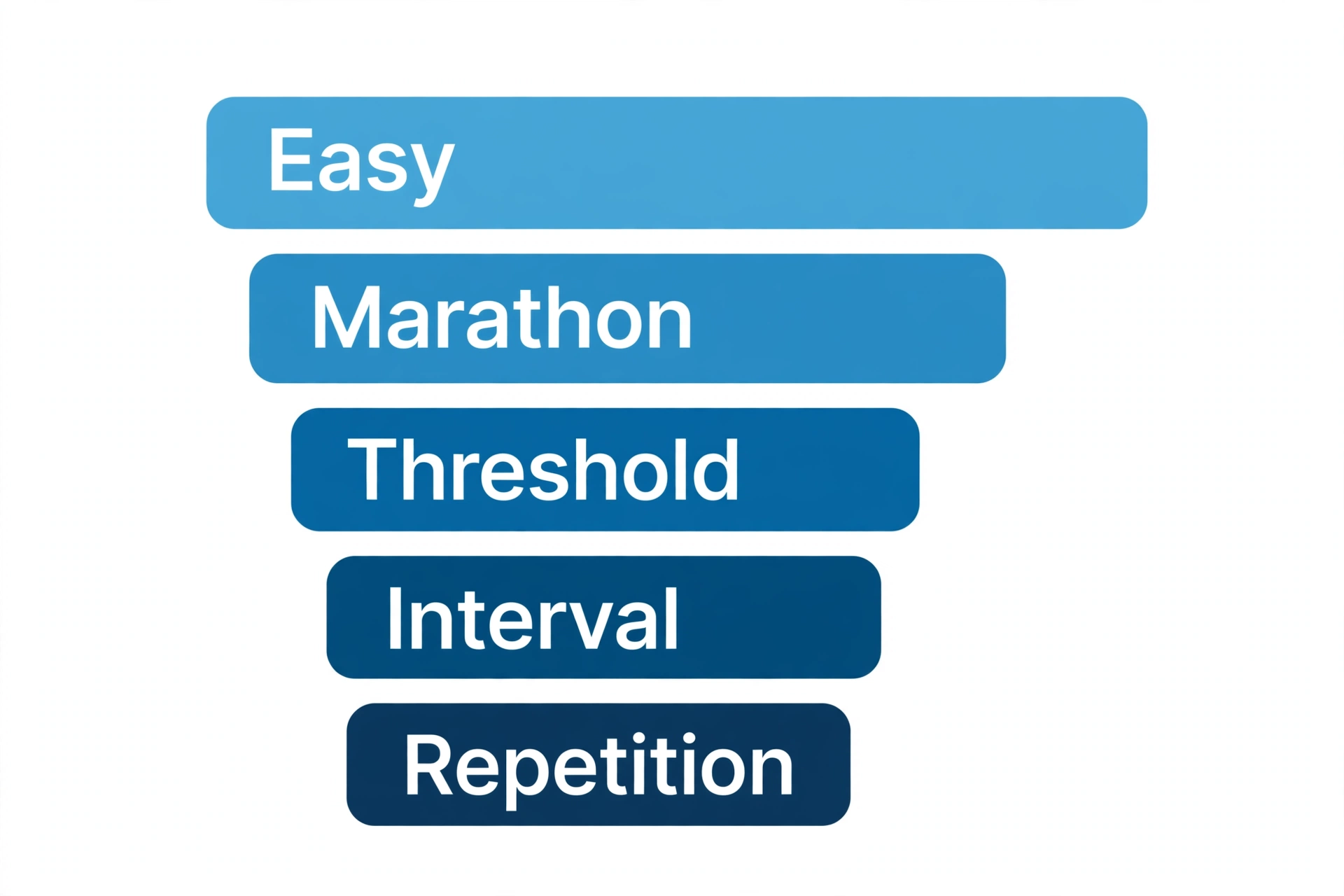
The five VDOT training paces are Easy, Marathon, Threshold, Interval, and Repetition.
Each pace is a share of your VDOT.
The table below shows the share, the heart rate, the use, and a sample session.
Use these tables as your VDOT pace calculator.
| Pace | Share of VDOT | Heart rate | Use | Sample session |
|---|---|---|---|---|
| E Easy | 59 to 74 percent | 65 to 79 percent of max | Warm ups, recovery, long runs | 30 to 45 minutes E |
| M Marathon | 75 to 84 percent | 80 to 90 percent of max | Marathon pace practice | 60 to 90 minutes M |
| T Threshold | 83 to 88 percent | 88 to 92 percent of max | Tempo runs, cruise intervals | 20 minutes T |
| I Interval | 95 to 100 percent | 98 to 100 percent of max | VO2max work, 3 to 5 minute reps | 5 x 3 minutes I |
| R Repetition | 105 to 110 percent | No set target | Speed and economy, 200 to 400 m reps | 8 x 200 m R |
Easy pace should cover most of your week.
It builds base fitness with low strain.
Run it at a pace where you can talk in full sentences.
The VDOT easy pace covers long runs and recovery days.
The VDOT threshold pace is for tempo runs.
It feels hard but steady for about 20 minutes.
It lifts your lactate threshold, so faster paces feel easier.
The VDOT interval pace is for VO2max work.
Use reps of 3 to 5 minutes with jog recovery of the same length.
The VDOT repetition pace is for speed work.
Use short reps of 200 to 400 m with full rest.
The VDOT marathon pace is for race practice.
Use it for long runs with fast parts in a marathon block.
VDOT for marathon training means M pace work in a marathon block.
Keep hard work in bounds each week.
Threshold work should stay near 10 percent of weekly distance.
Interval work should stay near 8 percent of weekly distance or 10 km.
Repetition work should stay near 5 percent of weekly distance or 8 km.
Avoid the gap between 88 and 95 percent of VDOT.
It is too hard for threshold volume and too slow for VO2max work.
Most steady runs that feel hard land in this gap by mistake.
Rest and sleep help the work take hold.
Each pace below sits at the middle of its band.
| Pace | VDOT 40 per km | VDOT 50 per km |
|---|---|---|
| Easy | 6:22 | 5:20 |
| Marathon | 5:31 | 4:37 |
| Threshold | 5:13 | 4:21 |
| Interval | 4:41 | 3:55 |
| Repetition | 4:20 | 3:37 |
Which Race Should You Use
Use your most recent race at full effort.
A result from the last 4 to 8 weeks works best.
A 5K or 10K gives the most trusted score.
These races test aerobic fitness best.
Very short races can read high.
A marathon can read low.
If two races differ, use the one closest to your goal.
A marathon VDOT often reads 1 to 3 points below a 5K VDOT.
Run on a flat course in fair weather when you can.
Heat, hills, and wind pull the score down.
No recent race is no problem.
Run a 5K time trial on a flat loop after two easy days.
Treat it as a race.
A treadmill time trial also works if the effort is truly full.
Common Mistakes
Do not enter a goal time instead of a real result.
Train at your current fitness, not the fitness you hope to have.
Do not run easy days too fast.
Easy pace leaves fuel for hard sessions.
Do not chase a predicted marathon time with no marathon training.
The table assumes full marathon training.
Do not update your score every week.
Small gains need time to show in a race.
Do not use road paces on trails or steep hills.
Use effort and heart rate there instead.
Do not use a hot or windy race.
It reads low and sets paces that are too slow.
When to Update Your VDOT
Update your score after each race or hard time trial.
Most runners retest every 4 to 8 weeks in a training block.
Raise your paces only when a result shows a higher score.
Do not raise them just because training feels good.
After illness or a break, drop your score a few points.
Rebuild from easy runs before you test again.
VDOT, Heart Rate and Effort
Pace, heart rate, and effort each guide training in a different way.
VDOT pace is exact and repeats well.
Your watch shows it each second.
It knows nothing about how you feel today.
Heart rate reads your body in the moment.
It lags, so it reads low on short efforts.
It also drifts up late in a long run at the same pace.
Effort sees sleep, stress, and sickness.
It is less exact than pace or heart rate.
Use pace to set the session.
If a session feels far harder than the pace suggests, ease off.
Limits of VDOT
VDOT is a model estimate, not a lab result.
It fits trained runners best, since the tables came from their data.
In one small study of 20 runners, VDOT from a 5K trial read below lab VO2max.
The gap was wider in the recreational runners.
In 23 master runners, VDOT and lab VO2peak tracked closely but were not the same.
The link was strong, with r equal to 0.845.
Threshold pace matched lab pace in recreational runners.
Interval pace read slower than the pace at VO2max.
No study gives a set accuracy figure for marathon predictions from a short race.
Treat the marathon time as a start point, not a promise.
Check it on a recent long run first.
Ask a health expert first if you are new or back from injury.
Frequently Asked Questions
What race should I use?
Use your most recent race at full effort. A 5K or 10K works well. A marathon also works if you raced it hard. Use a flat course when you can.
Can VDOT predict a marathon?
Yes, it can give a fair target time. Train well for the distance first. A first marathon often runs slower than the table. Use the table as a goal, not a promise.
Why are my paces slower than race pace?
Most training should feel easy. Easy pace builds fitness with less strain. Hard paces are for short, focused sessions. Slow down on easy days.
Does VDOT change with fitness?
Yes. As you train, your score should rise. Test it again after a new race. Update your paces when the score moves.
Is VDOT the same as VO2 max?
No. VO2 max measures oxygen use in a lab. VDOT is a running score from race times. The two are close, but they are not the same.
What does VDOT stand for?
VDOT is short for V-dot-O2max.
It writes VO2max with a dot over the V.
The dot marks a rate per minute.
How do I calculate VDOT by hand?
Find your speed in metres per minute from your race.
Work out the oxygen cost with the first formula above.
Work out the share with the second formula above.
Divide the first by the second.
What is a good VDOT score?
It depends on your age and your past scores.
Recreational runners often sit near 30 to 45.
A score of 50 means a 20 minute 5K and a 3:10 marathon.
Why is my marathon VDOT lower than my 5K VDOT?
That is normal and common.
Heat, fueling, and muscle fatigue limit a marathon more than a 5K.
Use the race closest to your goal when scores differ.
Can I use a treadmill or time trial result?
Yes, if the effort was truly full and the time is exact.
A flat outdoor race is still the best input.
Can I use VDOT on trails or hills?
Use it with care there.
Hills and rough ground slow your pace with no change in fitness.
Run those sessions by effort and heart rate instead.
Glossary
VDOT: a running fitness score worked out from a race result.
VO2max: the most oxygen your body can use in one minute.
Running economy: how little oxygen each metre of running costs you.
Lactate threshold: the hardest pace you can hold for about one hour.
Velocity: your running speed in metres per minute.
Sustainable fraction: the share of VO2max you can hold.
vVO2max: the slowest speed that takes you to VO2max.