 Calculator Metro
Stoichiometry Calculator
Type a chemical formula. Get its molar mass in grams per mole. Then change grams to moles, or moles to grams.
Use this free stoichiometry calculator to find molar mass and convert grams to moles. The tool above handles the molar mass step. It works as a grams to moles calculator and a moles to grams calculator. The guide below covers the full reaction steps: balance the equation, use the mole ratio, and find yield. Work through it with any reaction.
Find Molar Mass and Convert Moles
Start with a formula like H2O or Ca(OH)2. The tool lists each element and its mass.
Type a formula and press the button. Try H2O, CO2 or Ca(OH)2.
Grams to Moles and Moles to Grams
The molar mass from the step above fills the box below. You can also type a molar mass by hand.
Convert grams to moles, or moles to grams, with the molar mass above.
How It Works
Type a formula with capital letters for each element. Use H2O for water. Type a number after a symbol to show how many atoms it has. C6H12O6 has six carbon atoms. Use brackets for groups that repeat. Ca(OH)2 has two OH groups. Press Calculate Molar Mass. The table lists each element and its share of the mass. The molar mass fills the box below. Use it to change grams and moles. Type grams to find moles. Type moles to find grams. A mole is a count of particles. The molar mass links grams to moles.
What Is Stoichiometry?
Stoichiometry links the amounts in a chemical reaction. It uses the balanced equation to link reactants and products. The word comes from Greek: stoicheion means element, and metron means measure.
A balanced equation speaks in moles, not grams. The coefficients give the mole ratio. In 2H2 + O2 → 2H2O, 2 moles of hydrogen react with 1 mole of oxygen. The reaction forms 2 moles of water.
Every stoichiometry problem follows one map. First, convert the known amount to moles. Next, use the mole ratio to find unknown moles. Last, convert moles to the unit you need. That is how to do stoichiometry.
The mole is the bridge between grams and particles. One mole holds 6.022 x 10^23 particles. This number is Avogadro’s number. It is exact by the SI definition of the mole. That link is the mole concept.
Stoichiometry matters past homework. Labs use it to weigh reactants. Drug makers use it to set doses. Engineers use it for fuel and fertiliser amounts.
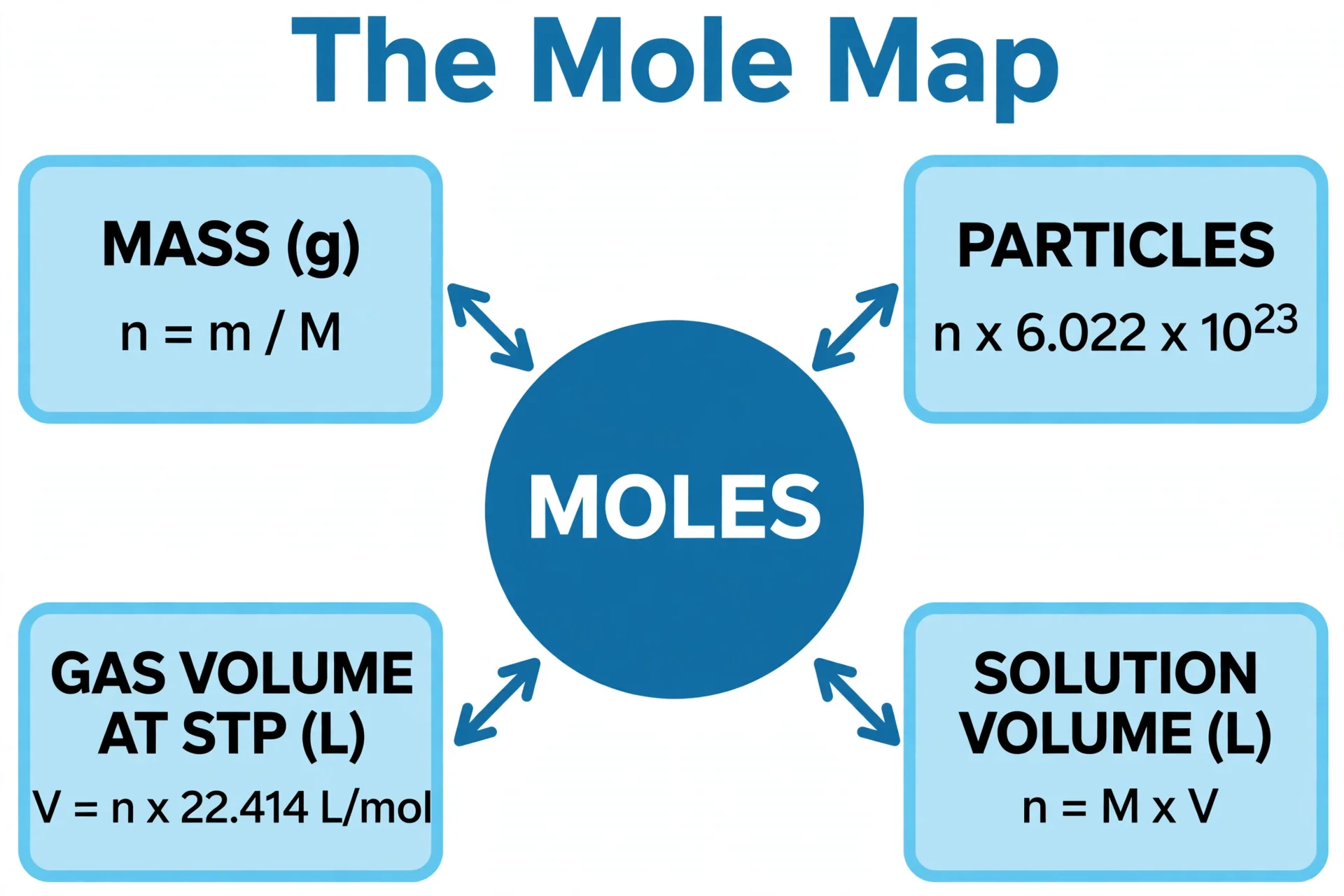
The mole map shows the four routes out of moles: mass, particles, gas volume and solution volume.
Stoichiometry Formulas
Keep these formulas close. Each one solves one step of the map.
| Formula | What It Finds | When to Use It |
|---|---|---|
| n = m / M | Moles | Convert grams to moles |
| m = n x M | Mass in grams | Convert moles to grams |
| n(B) = n(A) x (b / a) | Moles of B | Use the mole ratio; a and b are coefficients |
| Particles = n x 6.022 x 10^23 | Particles | Count atoms, molecules or ions |
| V = n x 22.414 L/mol | Gas volume at STP | Gases at 0 °C and 1 atm |
| n = M x V | Moles in solution | Molarity times volume in litres |
| Percent yield = (actual / theoretical) x 100 | Percent yield | Compare real yield with theory |
| Excess left = initial moles – moles used | Leftover reactant | After the limiting reactant runs out |
Here, n means moles, m means mass, and M means molar mass. The letters a and b are coefficients from the balanced equation.
How to Balance a Chemical Equation
Balance the equation before you use any ratio. An unbalanced equation gives a wrong ratio. Follow three steps.
Step 1. Count atoms of each element on both sides.
Step 2. Change coefficients only. Never change subscripts in a formula.
Step 3. Check that each element balances. The smallest whole numbers work best.
Example: H2 + O2 → H2O is not balanced. Oxygen has 2 atoms on the left and 1 on the right. Add a 2: 2H2 + O2 → 2H2O. Now hydrogen and oxygen both balance.
| Element | Reactants | Products |
|---|---|---|
| H | 4 | 4 |
| O | 2 | 2 |
Balance checks atoms and charge. It does not tell you if a reaction will happen. Lab conditions decide that.
Types of Stoichiometry Problems
Most stoichiometry problems fall into five types. The start and end units tell you the type.
| Type | Start | End | Key Step |
|---|---|---|---|
| Mole to mole | Moles of A | Moles of B | Multiply by the mole ratio |
| Mass to mass | Grams of A | Grams of B | Grams to moles, ratio, moles to grams |
| Mole to mass | Moles of A | Grams of B | Ratio, then multiply by molar mass |
| Mass to mole | Grams of A | Moles of B | Divide by molar mass, then ratio |
| Moles to particles | Moles | Particles | Multiply by 6.022 x 10^23 |
Gas and solution problems add one step. Convert litres or molarity to moles first.
You can also start from a product. Work the ratio back to find the reactants needed.
Limiting Reactant and Excess Reactant
The limiting reactant runs out first. It sets the most product the reaction can form. Other reactants are in excess. Some excess is left over at the end.
Do not pick the reactant with the fewest grams or moles. Divide each reactant’s moles by its coefficient. The smallest result is limiting.
Step 1. Convert each reactant amount to moles.
Step 2. Divide each mole amount by its coefficient.
Step 3. The smallest value is limiting. Use it to find the product.
Example: 28.0 g of N2 and 9.00 g of H2 form ammonia in the Haber process. N2 gives 0.9995 mol, and H2 gives 4.464 mol. Divide by the coefficients: N2 gives 0.9995, and H2 gives 1.488. N2 is limiting, even though H2 has less mass.
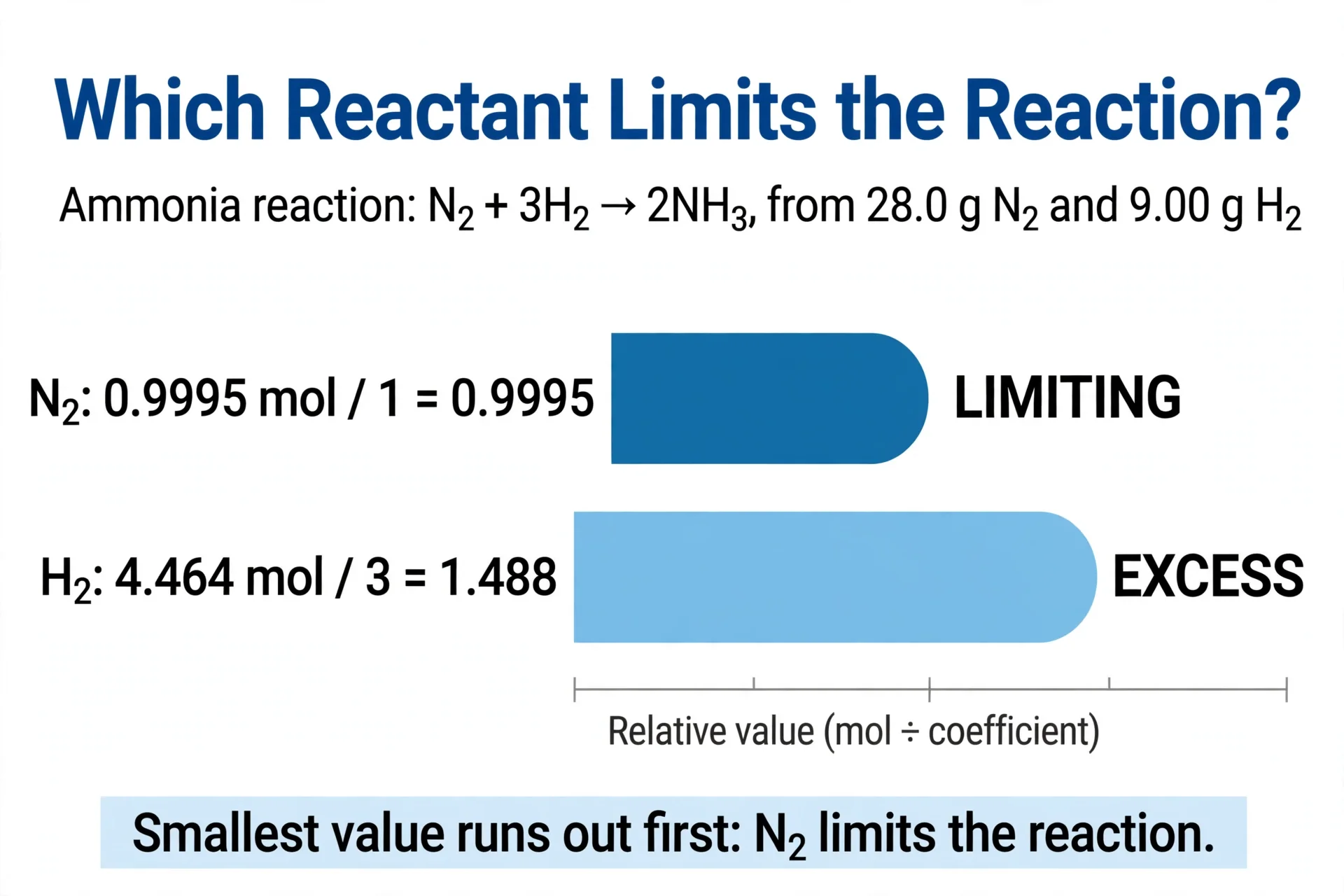
The chart shows the ratio test. The shorter bar limits the reaction.
Chemists also call it the limiting reagent. Both names mean the same thing.
Excess left is easy to find. Subtract moles used from moles at the start. The propane example below shows the full maths.
Theoretical Yield, Actual Yield and Percent Yield
Theoretical yield is the most product the reaction can form. It comes from the limiting reactant. It assumes a perfect reaction with no loss.
Actual yield is the product you collect in the lab. It is almost always lower. Some product is lost in transfer or left in the flask.
Percent yield compares the two. Percent yield = (actual yield / theoretical yield) x 100.
A yield over 100 percent points to a fault. The sample may be wet or impure. Dry it fully and weigh it again.
Worked yield examples appear below. One uses water, and one uses ammonia.
Solution Stoichiometry: Molarity
Molarity links moles and solution volume. Molarity M = n / V. Here V is in litres.
To find moles, use n = M x V. Convert millilitres to litres first. Divide by 1,000.
Example: 25.00 mL of 0.1000 M AgNO3 reacts with excess NaCl. First, change volume: 25.00 mL = 0.02500 L. Next, find moles: 0.1000 x 0.02500 = 0.002500 mol. Last, find mass: 0.002500 x 143.32 = 0.3583 g of AgCl.
Use the same steps for titration problems. Find moles from one solution, then use the mole ratio.
Gas Stoichiometry at STP
One mole of an ideal gas fills a fixed volume at STP. That fixed volume is the molar volume. STP means standard temperature and pressure. At 0 °C and 1 atm, the volume is 22.414 L per mole.
IUPAC now sets STP at 0 °C and 1 bar. There, the volume is 22.711 L per mole. Many textbooks still use 22.414 L per mole. Check which value your course uses.
At the same temperature and pressure, gas volumes follow the mole ratio. So 5.00 L of N2 gives 10.0 L of NH3. The ratio is 2 to 1.
Example: 36 g of water forms hydrogen gas. First, find moles: 36 / 18.015 = 1.998 mol. Next, find volume: 1.998 x 22.414 = 44.79 L of H2 at STP.
For other conditions, use the ideal gas law: PV = nRT. Here R is 0.082057 L atm per mol per K.
Worked Stoichiometry Examples
Five worked examples cover the main problem types. Each one shows every stoichiometry step. Round each answer to match your least exact input.
Example 1: Mole to Mole, Ammonia
Problem: How many moles of NH3 form from 1.50 mol of N2?
Step 1. Balance: N2 + 3H2 → 2NH3.
Step 2. Use the ratio: 1.50 x (2 / 1) = 3.00 mol of NH3.
Example 2: Mass to Mass, Calcium Carbonate
Problem: Find CaO from 100.0 g of CaCO3.
Step 1. Find moles: 100.0 / 100.09 = 0.9991 mol.
Step 2. The ratio CaO to CaCO3 is 1 to 1.
Step 3. Find mass: 0.9991 x 56.08 = 56.03 g of CaO.
The same step gives CO2: 0.9991 x 44.01 = 43.97 g.
Example 3: Limiting Reactant, Propane
Problem: React 44.1 g of C3H8 with 100 g of O2. Find CO2 formed and C3H8 left.
Step 1. Balance: C3H8 + 5O2 → 3CO2 + 4H2O.
Step 2. Find moles: C3H8 is 1.00 mol, and O2 is 3.125 mol.
Step 3. Divide by coefficients: 1.00 for C3H8, and 0.625 for O2. O2 is limiting.
Step 4. CO2 formed: 3 x 0.625 = 1.875 mol, or 82.52 g.
Step 5. H2O formed: 4 x 0.625 = 2.50 mol, or 45.04 g.
Step 6. C3H8 used: 0.625 mol, or 27.56 g. Left: 44.10 – 27.56 = 16.54 g.
Example 4: Percent Yield, Water
Problem: React 4.00 g of H2 with 32.0 g of O2. The lab collects 34.2 g of H2O. Find percent yield.
Step 1. Balance: 2H2 + O2 → 2H2O.
Step 2. H2 gives 1.984 mol, so the extent is 0.9921. O2 gives 1.000, so H2 is limiting.
Step 3. Theoretical yield: 1.984 x 18.015 = 35.74 g of H2O.
Step 4. Percent yield: (34.2 / 35.74) x 100 = 95.7 percent.
Example 5: Mass to Mass, Methane Combustion
Problem: How much CO2 forms when 16 g of CH4 burns?
Step 1. Balance: CH4 + 2O2 → CO2 + 2H2O.
Step 2. Find moles: 16 / 16.04 = 0.9975 mol of CH4.
Step 3. The ratio is 1 to 1, so CO2 is 0.9975 mol.
Step 4. Find mass: 0.9975 x 44.01 = 43.90 g of CO2.
Molar Mass Examples
Chemists count atoms in moles. One mole of a substance has a mass in grams equal to its molar mass.
Water has a molar mass of 18.015 grams per mole. So 18.015 grams of water hold one mole.
Table salt is NaCl. Its molar mass is 58.44 grams per mole.
Glucose is C6H12O6. Its molar mass is 180.156 grams per mole.
| Formula | Molar mass (g/mol) |
|---|---|
| H2O | 18.015 |
| CO2 | 44.009 |
| NaCl | 58.44 |
| C6H12O6 | 180.156 |
| Ca(OH)2 | 74.092 |
| H2SO4 | 98.072 |
To find moles, divide grams by the molar mass. For water, 36.03 grams give 2 moles.
To find grams, multiply moles by the molar mass. For water, 2 moles give 36.03 grams.
Molar Mass Reference Table
These molar masses use IUPAC standard atomic weights. The molar mass calculator above finds the same values for any formula. Each weight comes from the periodic table.
| Formula | Molar Mass (g/mol) |
|---|---|
| NH3 | 17.031 |
| CH4 | 16.043 |
| O2 | 31.998 |
| N2 | 28.014 |
| CaCO3 | 100.086 |
| AgCl | 143.318 |
| HCl | 36.458 |
| NaOH | 39.997 |
Atomic weights used: H 1.008, C 12.011, N 14.007, and O 15.999. Also: Na 22.990, S 32.06, Cl 35.45, Ca 40.078, and Ag 107.868.
Common Stoichiometry Mistakes
- Do not compare grams directly. Convert each amount to moles first.
- Do not skip balancing. An unbalanced equation gives a wrong ratio.
- Do not pick the smallest mole amount as limiting. Divide by the coefficient first.
- Do not use the excess reactant for yield. Theoretical yield comes from the limiting reactant.
- Do not mix up actual and theoretical yield. Percent yield needs both.
- Do not use 22.414 L per mole at other conditions. It holds only at STP.
Frequently Asked Questions
What is molar mass?
Molar mass is the mass of one mole of a substance. It is shown in grams per mole.
How do I type a formula?
Use a capital letter for each element. Add a small letter where needed. Type H2O for water and NaCl for salt.
Do brackets work in formulas?
Yes. Type Ca(OH)2 for calcium hydroxide. The tool counts the group twice.
How do I change grams to moles?
Divide grams by the molar mass. For water, 36.03 grams divided by 18.015 gives 2 moles.
Does it cost anything?
No. The tool is free to use. It runs in your browser with no sign-up.
What is stoichiometry?
Stoichiometry links amounts in a chemical reaction. It uses the balanced equation and the mole ratio.
How do I find the limiting reactant?
Convert each reactant to moles. Divide each by its coefficient. The smallest value is limiting.
How do I calculate percent yield?
Divide actual yield by theoretical yield. Multiply the result by 100.
What is theoretical yield?
Theoretical yield is the most product a reaction can form. It comes from the limiting reactant.
What does STP mean?
STP means standard temperature and pressure. At 0 °C and 1 atm, one mole of gas fills 22.414 L.
How do I balance a chemical equation?
Count atoms on both sides. Change coefficients only, never subscripts. Check each element again.
Can percent yield be over 100 percent?
A value over 100 percent points to a fault. The sample may be wet, impure, or misweighed.
How do I use this stoichiometry calculator?
Type a formula to find its molar mass. Use the molar mass to convert grams and moles. The guide above shows the full reaction steps.
Related Calculators
Proportion Calculator solves for an unknown in a ratio. Mole ratios work the same way. Percentage Calculator checks any percent, such as percent yield.